
Ubitium Completes First Silicon Tape-Out of Its Universal Microprocessor Architecture on Samsung 8nm
Düsseldorf, March 09, 2026 — , a German semiconductor start-up, today revealed the tape-out of its initial silicon using Samsung Foundry’s 8nm process. The tape-out was finalized in December 2025. The chip stands as the first universal RISC-V processor poised to replace the array of specialized processors employed in modern embedded systems.
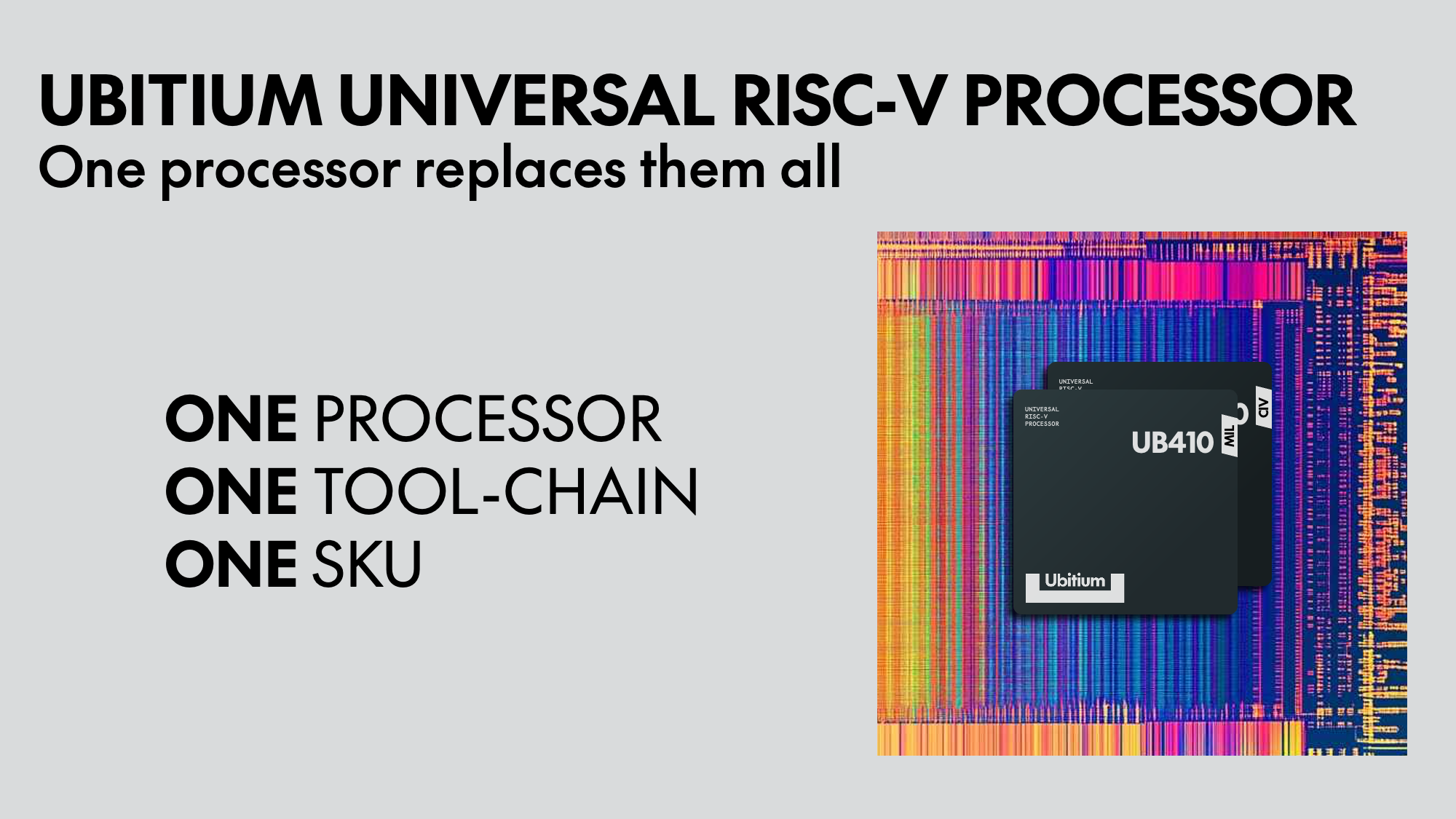
The $115 billion embedded computing market has reached a critical breaking point. Vehicles once operated with a single processor; today’s cars house more than 200, each with its own toolchain, software stack, and supplier. Performance is no longer the sole limiting factor—complexity now takes that role. As AI workloads expand into robots, drones, and industrial machinery, this complexity becomes unmanageable.
Ubitium builds upon RISC-V, the open-source architecture already used in billions of chips globally, and extends it beyond a conventional CPU. Its universal processor runs Linux and RTOS concurrently, manages radar and audio signals in real time, and executes neural networks for edge inference—all without separate accelerators or coprocessors. Full RISC-V software compatibility is maintained.

Ubitium Universal Processing Array.
“This tape-out transforms a long-standing concept into physical silicon,” said Martin Vorbach, CTO of Ubitium. “Embedded workloads have outpaced the architectures the industry currently relies on. Consolidation is no longer optional—it’s unavoidable.”
Ubitium’s approach for embedded computing mirrors what software-defined radio achieved for wireless technology: replacing fixed-function hardware with a single reconfigurable silicon. The outcome: embedded systems that can be brought to market faster, cost less, and have extended product lifecycles.

Ubitium core team.
Ubitium is collaborating with Samsung Foundry, Siemens Digital Industries Software, and ADTechnology as it progresses toward production silicon.
“The shift toward software-defined, reconfigurable compute is accelerating. Ubitium’s method—one universal processor replacing multiple specialized chips—aligns with where we envision embedded systems evolving. We’re proud to manufacture their first silicon.” Said Taejoong Song, vice president and head of Foundry Technology Planning Team, at Samsung Electronics.
“Shift-left verification enables teams to validate system behavior earlier by running more realistic workloads ahead of first silicon,” said Jean-Marie Brunet, Sr. Vice President, Hardware Assisted Verification, Siemens Digital Industries Software. “Ubitium’s utilization of Siemens’ EDA tools, specifically the Veloce CS hardware-assisted verification and validation system, highlights how early validation can mitigate integration risks, support design closure, and accelerate time to first silicon.”
“Delivering advanced-node silicon hinges on disciplined back-end execution across timing, power, and signoff,” said Jun-Kyu Park, CEO of ADTechnology. “We are pleased to have supported Ubitium throughout the implementation process as it advanced to tape-out on Samsung Foundry’s 8nm process.”
Ubitium’s founders have spent decades developing programmable architectures and the software stacks that enable their large-scale deployment. CTO Martin Vorbach created PACT XPP, an early commercial reconfigurable processor, and holds over 200 processor-architecture patents. The core team combines deep industry experience from Intel, Texas Instruments, Apple, and NVIDIA, along with more than 350 peer-reviewed publications.
The tape-out validates the foundational components of Ubitium’s architecture: the Universal Processing Array with runtime reconfiguration and LPDDR5 memory interface. A second tape-out is targeted for later this year, with volume production scheduled for 2027.
Technical Notes
- Workload coverage: Ubitium’s universal processor spans general-purpose computing, real-time signal processing, and massively parallel AI inference on a single die; within a homogeneous architecture
- Software stack: Full Linux and RTOS support, standard RISC-V toolchains, and compatibility with modern software frameworks. No need for proprietary languages or vendor-specific compilers.
- Target applications: Radar and multi-sensor signal chains, real-time audio and voice, computer vision, edge AI, automotive cockpits, industrial HMI.
- Runtime adaptability: The Universal Processing Array shifts execution mode at runtime (CPU, DSP, GPU, parallel accelerator) without context-switch penalty or external offload.
- System consolidation: One processor, one toolchain, one qualification cycle. Reduces BOM cost, board complexity, and supplier dependencies across product lifecycles.
.
About Ubitium
Ubitium is developing a universal, runtime-reconfigurable RISC-V microprocessor designed to reduce embedded computing complexity and cost across consumer electronics, automotive, and defence & space. The company’s goal is a single, adaptable compute platform that helps make future devices more autonomous and resilient. To learn more, visit
CONTACT: For further information please contact the Ubitium press office: Bilal Mahmood on b.mahmood@stockwoodstrategy.com or +44 (0) 771 400 7257.
